


Tuesday, October 16, 1990
9 PM. I attended the 2 Live Crew trial from its start at 9 AM till it recessed after 5 PM, and once again, it was an amazing experience to be in the courtroom.
I now feel like I know the attorneys: the prosecutors Robson and Dijols and Bruce Rogow for the defense. (There are two other defense attorneys, presumably one each for the three defendants.)


I told Sara Rimer from the New York Times how much I liked her series on the Bronx public school; I’ve admired her work since she was the Herald’s New York City correspondent.
Also here are a guy from the L.A. Times, a woman from the Washington Post, people from USA Today and the Voice and other publications.
I can’t tell if anyone is covering this with a book in mind, so maybe I should try to pitch a nonfiction book (Rap on Trial?) to an agent and see what happens.


Maybe I should have been a journalist myself because I like talking to bright media people, and I’m such a big reader that I can hold my own in conversation with them.
But I don’t think I’d enjoy writing on deadlines, although it might be terrific practice for me to try to come up with a story I’d have to file quickly.


The six jury members include a black woman and two guys in their early twenties, as well as a 76-year-old retiree (though not a typical one, since she’d been a professor at Wellesley).
The state’s first witness, Detective McCloud (the same guy who bought the album at E-C Records and arrested Charlie Freeman), ran into trouble on cross-

Because of foul-ups, the digital tape the prosecutors want to introduce into evidence (and played for an hour this morning – it was extremely garbled and difficult to understand) may be tainted evidence.
The judge, June LaRan Johnson, a heavyset blonde woman (a former student – but not a great one, by her own admission – of Rogow’s), will rule on that when the trial 

I hope to be there. Yes, some of the procedures are tedious, but watching Bruce Rogow discover, step by step, just what happened with the tapes, was utterly fascinating, and it made me see the deep intellectual challenges that the law can provide.
Robson still strikes me as too prickly, but maybe she has to act that way as a prosecutor.


In fact, now that I’m nearly 40, it strikes me that all these people – attorneys, defendants, judges, journalists – are kids. It’s as if I’ve discovered the secret of all the world’s important business: nobody’s more of an adult than I am, really. Well, now I sound inarticulate.
I went out for lunch and for frozen yogurt during two breaks today.
Wednesday, October 17, 1990


I didn’t do too bad when I did aerobics at 6:30 AM today, either. Because I wanted to get to court early, I didn’t feel like putting off my exercise until evening as I did yesterday.
At 9 AM, I was outside the courtroom, where Judge Johnson had her usual docket of misdemeanor cases. I sat on a bench with Chris Wong Won and Mark Ross, the 

The talk of the day, as the attorneys and media people began entering, was Sara Rimer’s front page story in the Times, with Rogow and Luke on the cover in a photo (and Rogow and Robson portrayed on the jump page inside).
Because I had my notebook, the bailiff told me to sit with the media. Sara didn’t 

There’s this cute long-haired blond guy, Todd, a reporter for the Palm Beach Post, who’s obviously gay; I’ve liked him since the Freeman trial, but he’s studiously avoided even glancing at me.


The 2 Live Crew case is going to go on for a long time. Today they kept playing snippets of the barely audible tape, interrupted by Detective McCloud saying who was singing or talking what was said.
I left at 5 PM, so I don’t know if they ever got around to cross-examination, but Rogow withdrew his objection to the tape being introduced and said he’d bring up 

McCloud twice led to mistrial motions when he inadvertently brought up the verboten transcript of the show and the juvenile concert.
Basically, today’s testimony was exceedingly tedious.
Without a videotape or clear audiotape, it’s hard to prove obscenity because hearing it in such a disjointed fashion makes the whole performance difficult to follow or visualize it “taken as a whole” (the Miller guideline on obscenity).


When I got home, there was a message to call Betty. She’s decided to give me English 102 course, which delights me because it’s better than English 101: it’s more interesting to teach because it involves literature, and the students in it have all passed English 101 and so presumably are better writers.
The class begins Saturday, of course, and I need to make up a syllabus and plan the eight weeks, so I won’t be able to see all of the trial – which will probably go on past this week. I feel sorry for the bored, sequestered jury.
But I’m happy to be back working at Broward Community College; I need the job, if only to anchor me in some structured activity besides attending trials.
Thursday, October 18, 1990


When I read Dexter Filkins’s report on the trial in the Herald early this morning, I discovered that McCloud had been on the witness stand interpreting that lousy tape until 7 PM.
During a break, the jury sent the judge a note asking for permission to laugh 

I’ll be shocked if 2 Live Crew isn’t acquitted within an hour of the start of deliberations – but then I was pretty shocked by the Freeman verdict.
Nevertheless, I think I know this jury better, and Rogow won the case when the jury got picked after he took six days to get the people he wanted.


While the detective never lost his composure, Rogow basically humiliated him, at one point making him get up and show how the go-go dancers were moving.
It was hard to watch an overweight middle-aged black man make those moves, and it made him look ridiculous.
The defense established that there was much more going on at Club Futura than the words on the tape and the bawdy or lewd gestures the detective had described.

Mrs. Campbell, Luther’s mom, was in the courtroom, as was the judge’s elegant mother; at different points, both were sitting next to me.
I saw fewer press people today, or at least different ones.


I hope it goes on till that afternoon, so I can be there for the verdict.
After McCloud left the stand at about 12:30 PM, they called Detective Debbie Worder, who apparently was going to go through the same tedious process of listening to and paraphrasing the tape of the concert.

On the way, I passed the scene of the alleged crime, Club Futura, on Hollywood Boulevard and Dixie Highway.
Betty gave me the room number for my class and we talked about how to get all that extra work in. Eight 4-hour classes aren’t sixteen 3-hour classes, and I suspect that even with extra assignments, the workload will be less than the equivalent of a normal term.


I’m surprised at how pleased I am to be teaching again and how good it felt to be at BCC-South among friends. . .
I feel like I’m starting to have a full, busy life again. It’s still 88° or more every day, and going out at night is problematical because of the mosquitoes spreading St. Louis encephalitis. But winter – the golden season here – will come eventually.
Friday, October 19, 1990


Todd Woody of the Palm Beach Post, sitting nearby, wouldn’t acknowledge my presence, so it’s obviously useless to consider him a potential friend.
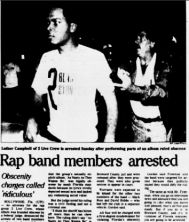
A lot of talk has started about the cost of the trial, around $100,000. I think by now even Nick Navarro realizes that he opened up a terrible can of worms with the high-publicity arrests.

They are both victims – non-artists, non-performers – like the Cincinnati art museum director Dennis Barrie, of this witch hunt or cultural war or censorship campaign.
I was impressed when Newsday’s John Leland said, “Hello, Richard,” to me as he entered courtroom. He and Henry Louis Gates were testifying this morning, going out of turn because they’ve been here at the 

I sat in the back of the courtroom with two high-school guys who told me they’d come to “support the band” and to report back to their classes. They asked me questions and I explained some stuff to them.
Dr. Gates was an incredible witness. As I said to these kids, he’s like the superstar of English professors, and he was brilliant, expounding on signifying and the dozens and rap’s place in African-American culture; giving examples from Zora 

It’s hard to believe such an erudite man is only my own age. Pedro Dijols tried to shake the jury’s faith him, but he just couldn’t score.
During the break, I shook Dr. Gates’ hand and told him I was “an English teacher at the local community college” who admired his works, and he was very kind.


After a lunch break, their second witness, Detective Debbie Worder, continued to be terrible – but it was hard to succeed at the task she and McCloud had to accomplish, playing a few minutes of that inaudible tape and then “translating” it.


This woman could understand what Gates and Leland told the jury, saying the words in 2 Live Crew’s songs, “like all art and literature, aren’t meant to be taken literally.”


(Mark Ross calls the frequent sidebars “salad bars.”)
I left at 5:30 PM and when I got home, they said Rogow was cross-examining Worder.


Hopefully I’ll get to court before a verdict is reached tomorrow afternoon, but unfortunately the verdict may come quickly; I can’t imagine this panel – unlike the Freeman jury who voted to convict – doing anything but voting not guilty.
Saturday, October 20, 1990
9 PM. Because of my BCC class, I didn’t get to the trial till 12:30 PM, and they 

But after a break, I got to hear Pedro’s final talk to the jury and judge’s charge, which I told Rogow in the men’s room should be called “Miller time” (after Miller v. California).
I figured I had time to get a salad at Wendy’s on SE 17th Street, and when I got back, I sat down in the courtroom next to one of the released alternate jurors, who told all the reporters that he never even considered a guilty verdict.
And I’d have been shocked at one myself, especially after I found myself in an elevator with Pedro with only the two of us in it, and he said bitterly, “This case was the worst piece of crap I’ve ever had.”


As we waited, I talked a lot to Jeanne DeQuine, who’d been writing for USA Today, and Susan Grey from WINZ and Charlie Freeman and others.
When the buzzer sounded at 4:10 PM, everyone rushed around as word came in that jury had reached a verdict.


When the court clerk said the first verdict, finding Luke not guilty, he jumped for joy and the courtroom erupted into cheers.
I’ve seen the scene on videotape now – it led the NBC Nightly News as well as the local shows – and I can be seen clearly just behind Luke Campbell and in front of 

Chills ran down my arms, and my eyes started welling up with tears. I didn’t shout like some others, but I felt good, and in some way this verdict made up for what happened in the Freeman case – but not quite.
It was an exciting scene as flashbulbs popped and lights glared and we moved to a press conference in an adjoining room.
Bruce Rogow spoke first, about the freedom of speech, even offensive speech, and the 

“We had a fair jury,” he told the crowd, and he made some nice remarks about “the supportive people of Broward County.”
I know it’s a victory for the First Amendment, but there’s still the federal appeal of Judge Gonzalez’s obscenity ruling, and Charles Freeman’s appeal, and next week’s trial as well.


Actually, the class seems like a delightful group: all adults, some professional people, some who say they like writing and literature.
But when we came back from the break, I did what I’ve done before in English 102: read aloud Flannery O’Connor’s “A Good Man Is Hard to Find.”


The word nigger, used twice in dialogue of the grandmother, so blinded her that she couldn’t – despite all my reasonable talk and the arguments of other students – see that it wasn’t the author of the story insulting her personally.
It really made me feel lousy, actually, even though the woman said she wasn’t accusing m

Not being able to explain the difference between a person’s racial insult and an author’s attributing a racist remark to an unsympathetic character in a story over forty years old – well, that just about made me want to give up teaching altogether.
If we can’t represent life as it is or what it was, then can artists do anything? Probably I could manage to get an Op-Ed piece out of this – Is there any difference between this woman wanting to ban our textbook and Broward County wanting to censor 2 Live Crew? What advice would Prof. Gates give me if I wrote him? – but I’d rather have avoided the experience.
I haven’t read today’s or yesterday’s Times and I’m too tired to do anything now but close my eyes.
*

Do I need to be accused, even indirectly, of racism because I teach – and enjoy – a story that twice contains the word nigger? Is what happened to Salman Rushdie going to happen to every writer who offends a particular group?
Are fewer people intelligent enough, as I am, to appreciate writers and artists who nevertheless are racist, sexist, anti-Semitic, homophobic? I like Henry Adams and Celine 

When I was in grade school, we talked about tolerance: that condescending word. Is the new tolerance lack of tolerance?
Okay, we’re dealing with community college students here. These are the same students who thought the story in Crad Kilodney’s bad short story anthology were good.


When I feel I should be ecstatic over the 2 Live Crew verdict, I can’t relax because I see threats to free expression popping up everywhere now. Instead of feeling relieved and hopeful, I just want to get away from other human beings.
Sunday, October 21, 1990


I’ve seen myself on TV every time the 2 Live Crew story comes on the news.
On the TV news shows and in the papers, the jurors said they found the lyrics funny and felt the charges 

Jesus.